
Embrace Constraints and Find the Photograph That Is There
If you enjoy posts like this, please support my work and support independent photography tutorials like this.
Photography rarely gives us exactly what we expect. The weather changes. The light falls flat. The equipment we planned to use stops cooperating. When that happens, it is easy to spend the entire outing thinking about the photographs we can no longer make.
A recent trip to the ocean gave me two different constraints. The first came from the conditions. The second was entirely my own doing. Together, they forced me to rethink the photographs I was trying to create.
The lesson was a useful reminder: constraints do not necessarily end a productive outing. Sometimes they help us focus on the possibilities that remain.
When the Conditions Offer Very Little
The weather that day was heavily overcast. There was nothing happening in the sky, and the surf was low and uninteresting. Even when the waves reached the shore, the water moved slowly. I wasn’t getting the strong surges or directional lines that can add energy to a seascape.
That immediately removed several possibilities.
A wide composition emphasizing the sky wasn’t going to work. The sky had no texture, color, or light worth featuring. The slow-moving water also wasn’t producing the well-defined lines I like to use to lead the eye through a foreground.
Rather than continuing to look for a dramatic seascape that wasn’t there, I narrowed my attention. If the sky had nothing to offer, I needed to look downward and find my subjects among the rocks.
Let the Constraint Focus Your Attention
A limitation can be frustrating, but it can also simplify the choices in front of you.
Knowing the sky and surf would not carry the photograph, my attention shifted to the shapes and relationships in the foreground. I looked for interesting rock formations and arrangements where the individual elements worked well together.
The ocean could still play a role, but it would become a supporting element rather than the main attraction. The rocks would provide the structure of the composition. The water would help separate them and add atmosphere.
This is one of the useful things about embracing a constraint. It removes options that are not working and gives you a smaller, more focused problem to solve.
The goal is not to pretend the conditions are better than they are. It is to recognize what the scene can offer and build the photograph around that.
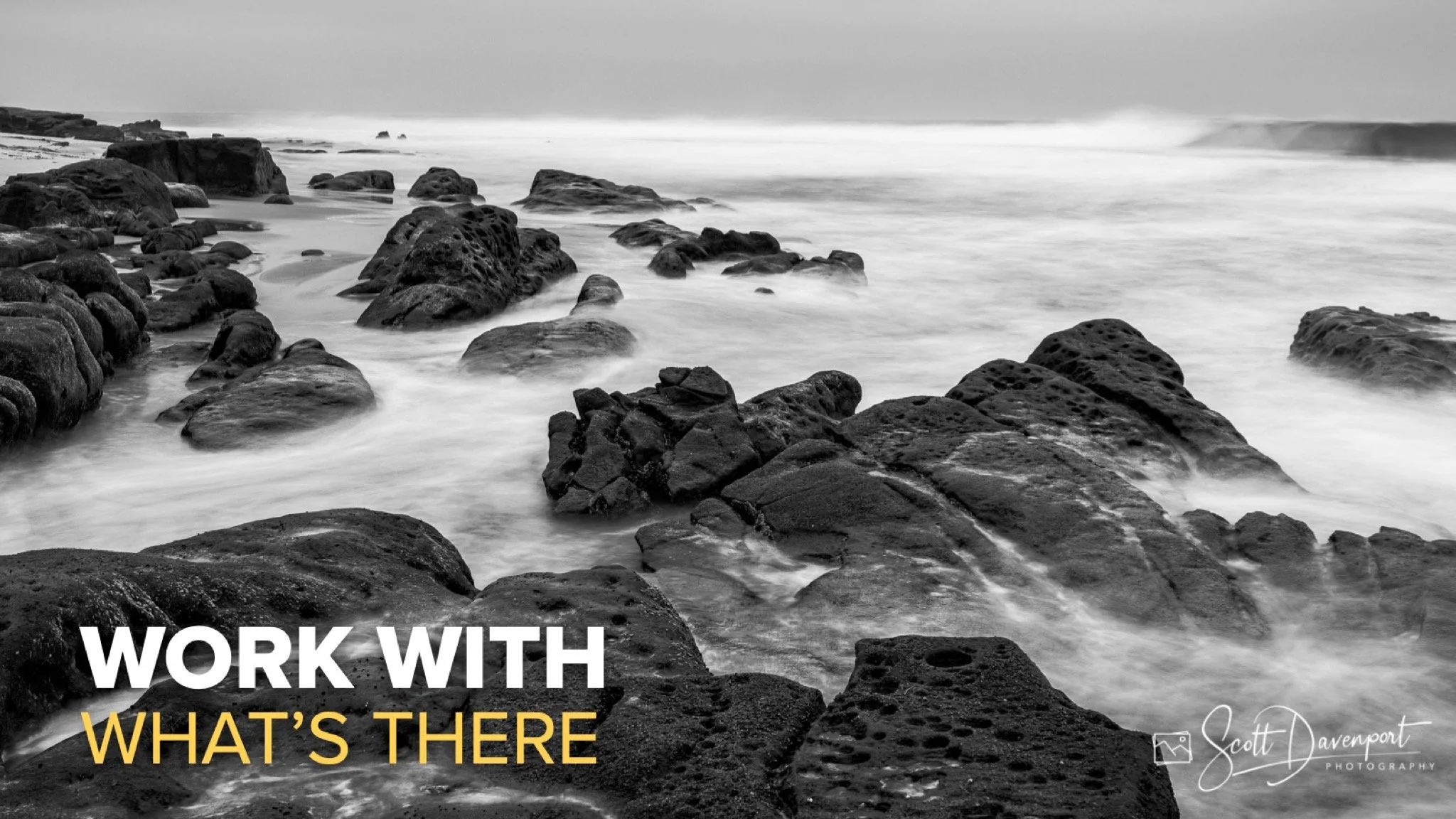
A lackluster sky and slow, uninspiring surf focused my attention to the foreground. Without my remote trigger operating, timing the exposure to capture the water movement was challenging.
When the Equipment Stops Cooperating
The second constraint was technical—and self-inflicted. The battery in my remote trigger was dead.
That matters for the way I often photograph moving water. I like working with exposures around half a second, one second, or two seconds. At those shutter speeds, timing is important. I want to begin the exposure as the water enters the composition so its motion creates useful lines through the frame.
Without the remote, I had to use the camera’s two-second timer. Now I wasn’t simply predicting where the water would go. I had to predict what it would be doing several seconds in the future, start the timer, and hope the exposure began at the right moment.
The results were inconsistent. In some frames, the water was too lazy and shapeless. In others, I completely missed the ebb or surge I was trying to capture. I did get one frame that was reasonably successful, but overall I was fighting the timing.
That was the signal to stop forcing the original approach.
Change the Photograph, Not the Conditions
I could not make the surf more energetic. I could not restore the remote trigger’s battery. What I could change was the type of photograph I was making.
Instead of continuing with shorter exposures that depended on precise timing, I moved toward much longer exposures. With exposures lasting several seconds, the exact starting moment became less important. The movement of the ocean blended together, creating smoother, smokier water around the rocks.
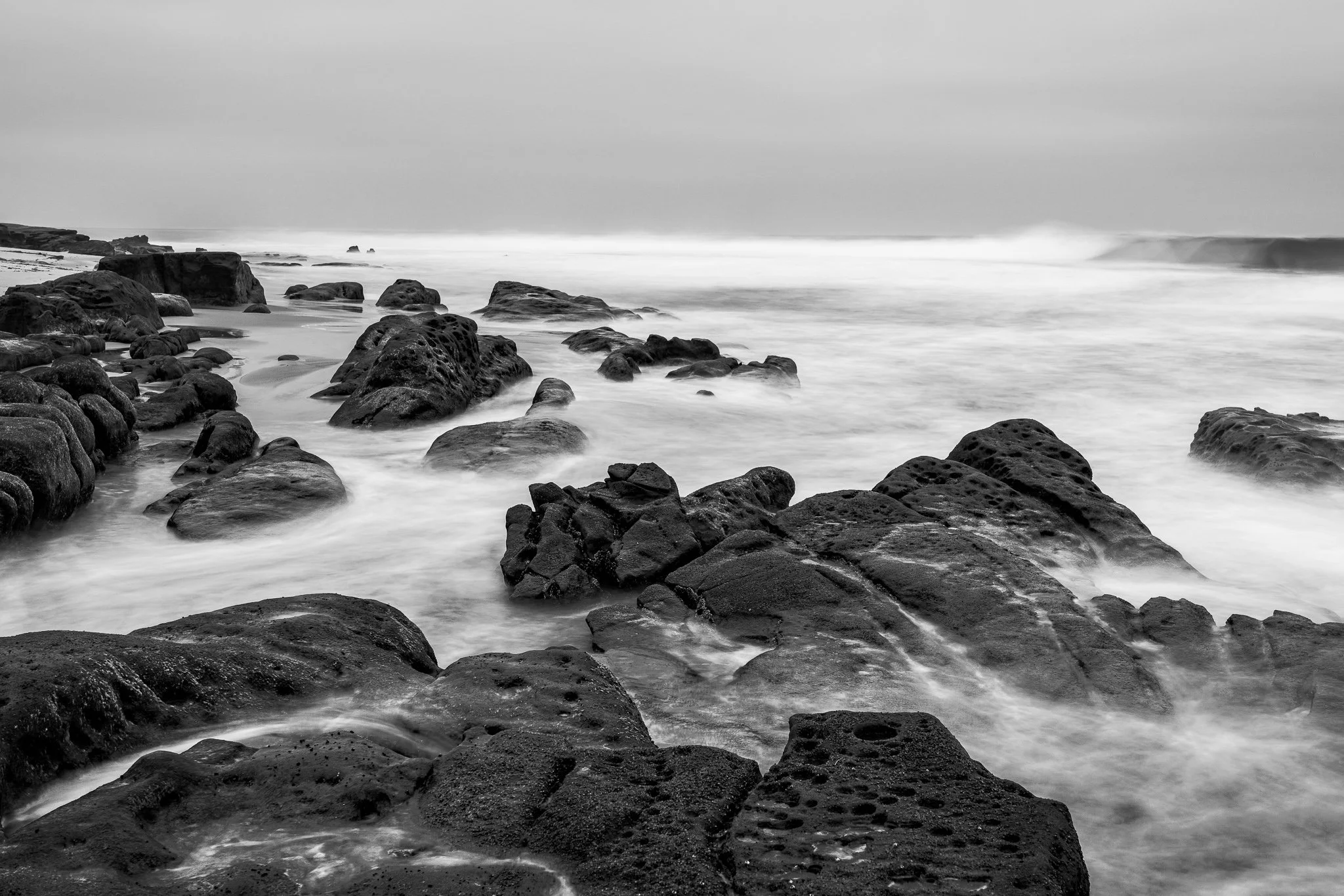
I also changed my position and adjusted the composition. From the new angle, the rocks had better separation and the longer exposure gave the scene a quieter feel. After several attempts, I found a frame where the elements had enough breathing room and the water supported the composition without overwhelming it.
The constraint had not disappeared. I had simply chosen an approach where it mattered less.
That distinction is important. Adapting in the field does not always mean finding a clever workaround that lets you make the photograph you originally imagined. Sometimes it means recognizing that a different photograph is the better answer.
Photograph What the Scene Supports
The final composition was not built around a dramatic sky or powerful surf. It was a study of rocks, separation, shape, and softly moving water.
Even the strip of blue-gray sky at the top of the raw capture will probably be cropped when I process the image. It does not contribute anything useful. I included a little extra space in the field because I had plenty of resolution and wanted some latitude in post-processing, but the finished photograph does not need to preserve everything the camera recorded.
That is another part of working with constraints: be honest about which elements are helping.
If the sky is empty, minimize or eliminate it. If the water lacks direction, let it become texture rather than structure. If one technique depends on timing you cannot reliably control, choose another technique.
You are not obligated to make every part of the scene important.
Pivoting to longer exposures overcame the problems of timing the start of the exposure. I also shifted my perspective so there were more foreground and midground rocks through the frame.
Apply the Idea Beyond Seascapes
My example happens to be a seascape because that is where I frequently photograph, but the same thinking applies anywhere.
You may arrive at a landscape and find harsh light instead of the soft conditions you expected. A trail closure may keep you away from a planned viewpoint. A forgotten lens may limit your choice of focal lengths. Wind may make long exposures or delicate foreground subjects impractical.
In each case, the first reaction is often to focus on what is no longer possible.
A better set of questions is:
What does the scene offer right now?
Which subjects still work in these conditions?
Can I simplify the composition?
Can I change my position, focal length, or exposure strategy?
Is there a different photograph here than the one I planned?
Those questions direct your attention toward making photographs again.
Final Thoughts
Constraints are part of photography. Some come from the weather or landscape. Others come from our equipment—or from forgetting to check a battery before leaving home.
The important thing is how you respond.
Rather than lamenting that you cannot do X, Y, or Z, look for A, B, or C. Let the limitations narrow your choices, focus your attention, and point you toward the photograph the scene can actually support.
La Jolla, July 2026
Contact Scott to commission a print or license this image.




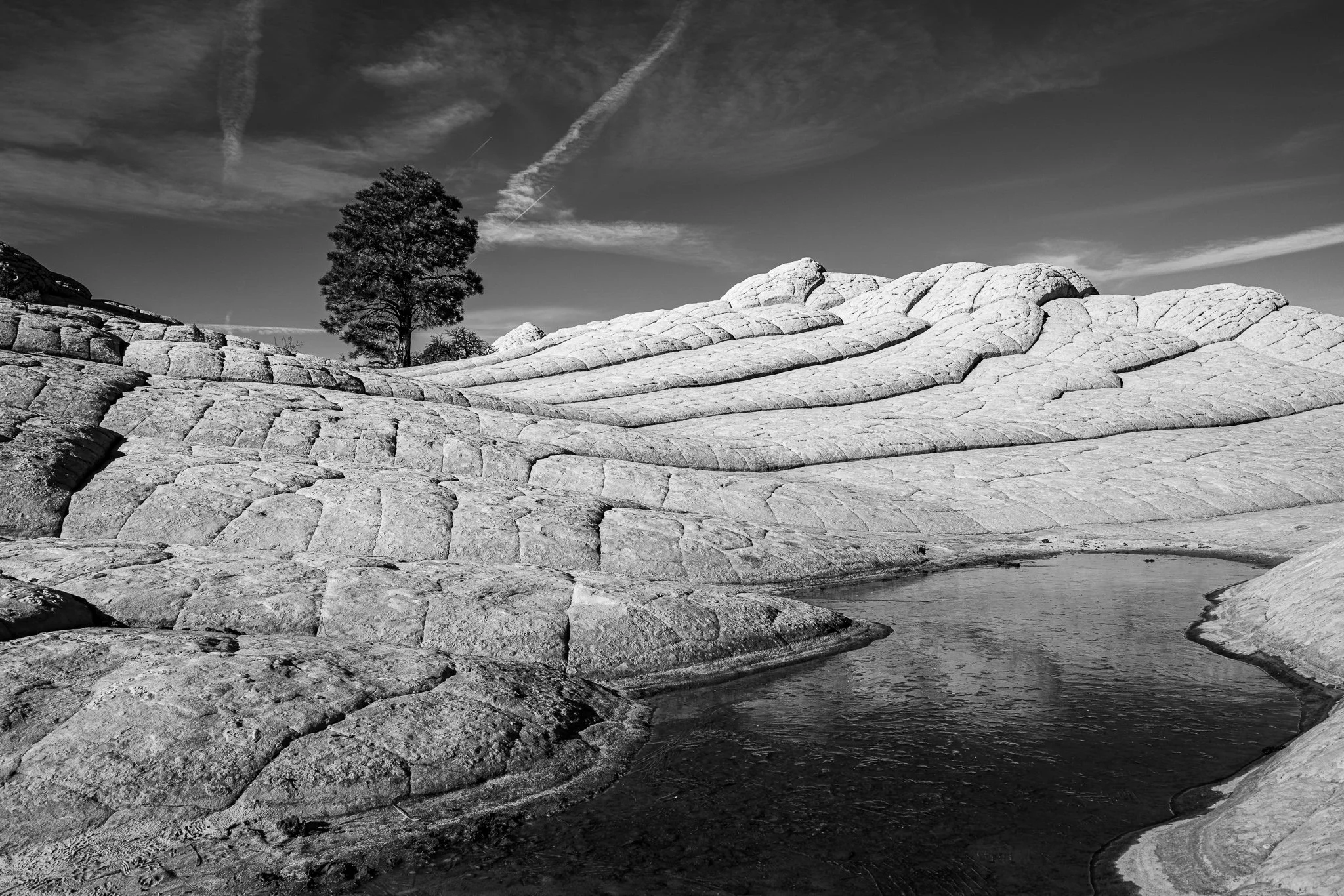



A vignette can help guide the viewer toward your subject, but lowering exposure around the edges of a black and white photo can quickly bury important shadow detail.
In this quick tutorial, I’ll show you a more controlled approach using a radial gradient and the Whites or Highlights slider. You’ll still get that visual nudge toward the subject without making already-dark areas disappear.